Understanding
Chemical-Free Bathroom — Why Your Daily Products Matter, and the Kitchen Swaps That Replace Them
Toothpaste, soap, shampoo, cream, perfume — and a quiet question about what they do inside us, and to our rivers.
Helps with

By PranaJiva
Editorial Team
Key facts
- An average woman uses several personal-care products a day. A US survey by the Environmental Working Group counted about 12 products and 168 ingredients.
- Parabens and phthalates are called endocrine disruptors: chemicals that can interfere with the body's hormone signals. Research links them to hormonal imbalance, fertility concerns and skin problems. The evidence is still being studied.
- Liquid products — lotion, shampoo, liquid soap, juice, cold drinks — spoil quickly without help. Preservatives are what let them sit on a shelf for 6 to 12 months.
- Powder-form products need no water, so they need no preservative.
- Whatever we wash off flows through drains into rivers, ponds and soil.
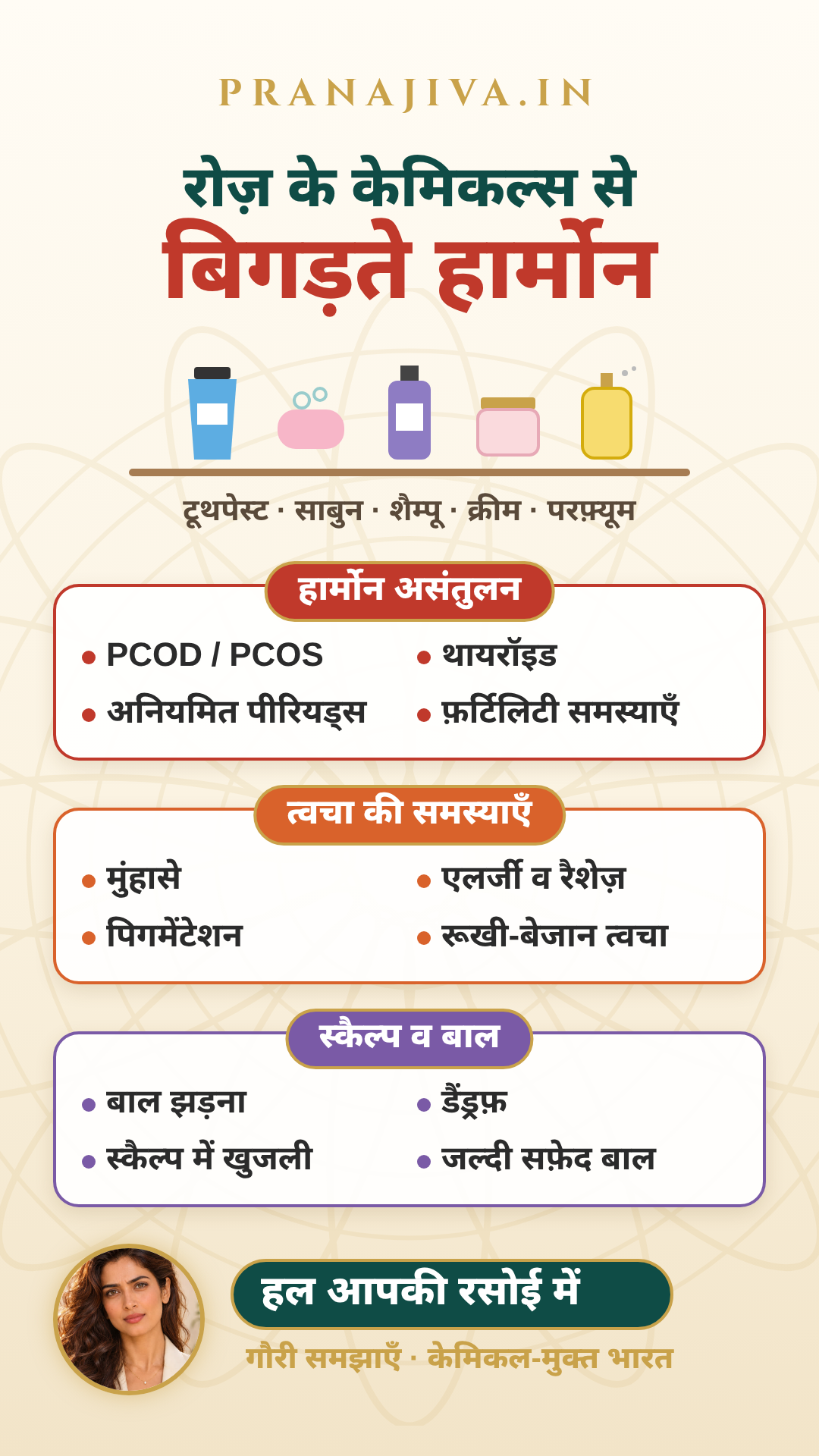
Morning starts with chemicals before we have even had tea. Toothpaste, soap, shampoo, face cream, a spray of perfume — each one is a small mix of ingredients we rarely read. Meanwhile, conditions like PCOD, thyroid trouble, early hair fall and childhood skin allergies have become common conversation in almost every home. They have many causes. But it is fair to ask what part our daily products play.
What the concern actually is
Some chemicals used in cosmetics, such as parabens (preservatives) and phthalates (often hidden under "fragrance"), can mimic or block hormones in lab and population studies. Scientists call them endocrine disruptors. Research is connecting them with hormonal imbalance, fertility concerns and skin problems — though how much a typical daily dose matters is still debated. The honest position: not proven harm, but enough signal to reduce exposure where it is easy to do so.
The bigger question is simple — do these chemicals stay on the skin, or do they travel inward? Some are absorbed through skin, and some reach us through food and drink packaged with the same preservatives.
Why liquids need preservatives
Think of home-cooked food. Left out of the fridge, it spoils within hours. Anything with water in it behaves the same way — lotion, shampoo, liquid soap, packaged juice, cold drinks. To make them last 6 months to a year, manufacturers have to add preservatives. That is not a conspiracy; it is chemistry. Remove the water, and the need for preservatives largely disappears. That is why powders, ubtans and pastes made fresh at home were the norm for generations.
The answer is in your kitchen
Ayurveda kehta hai — what you would not eat, think twice before putting on your skin. Our grandmothers' bathroom shelf was really the kitchen:
- For bathing: besan, curd, haldi, multani mitti, or masoor dal powder.
- For the face: rose water, aloe vera, coconut milk.
- For hair: reetha, shikakai and amla, with coconut oil on top.
- For teeth: a neem or babool datun, or a haldi-and-salt manjan.
Start with one swap — the bathing ubtan is the easiest — and add the next when it feels natural. Returning to a natural routine is not a big leap. It is a few small steps.
If you have no time to make them, look for powder-form versions — no water, so no preservative needed.
Your bathroom drain reaches the river
Shampoo foam, soap and face wash do not vanish. They travel through drains into rivers, ponds and soil, and many synthetic ingredients break down slowly. Natural ingredients like besan, reetha, neem and haldi blend back into nature without harm. When we look after nature, nature looks after us — our health and our earth improve together. This is the heart of a Healthy Bharat, Chemical-Mukt Bharat.
This article is traditional guidance for general wellbeing, not a diagnosis or treatment. If you have a hormonal condition, PCOD or a skin disorder, please speak to a qualified health professional before changing your routine. Patch-test any new ingredient on a small area of skin first.
This is traditional Ayurvedic guidance shared for general wellbeing. It is not a diagnosis and not a substitute for medical advice. If a symptom is severe, persistent or worsening, or you are pregnant, taking prescribed medicine or managing a diagnosed condition, speak to a qualified doctor before trying it.
Pairs well with this
Other ways to approach the same thing.
- Understanding· Chemical-Free Living
Monthly Bathing Ubtan
A five-ingredient kitchen powder you make once and use every day in place of soap — for the whole family, all month.
- Understanding· Women's Health
Shatavari, Shatapushpa & Dalchini — three herbs Ayurveda turns to for PCOD and PCOS
One root, one seed, one kitchen spice — and a fifteen-minute habit that matters as much as any of them.
- Understanding· Chemical-Free Living
The herb on the wrapper — and what is inside the bar
How a factory turns palm oil into "neem" soap, why ubtan was the original herbal cleanser, and where the foam goes after your bath.
More in Chemical-Free Living
- Understanding· Chemical-Free Living
Monthly Bathing Ubtan
A five-ingredient kitchen powder you make once and use every day in place of soap — for the whole family, all month.
- Understanding· Chemical-Free Living
The herb on the wrapper — and what is inside the bar
How a factory turns palm oil into "neem" soap, why ubtan was the original herbal cleanser, and where the foam goes after your bath.
- Understanding· Chemical-Free Living
The white film on your plate — and the ash that once kept it away
What dishwash bars can leave behind, where the foam goes next, and how a jar of upla ash can replace the bar.