Understanding
Feet First, Head Last
An old bathing habit from the river ghats, why it still makes sense under a modern shower, and how to do it.
Helps with

By PranaJiva
Editorial Team
- Form
- Bathing routine
- Time
- No extra time — just a different order
- Best time
- Every bath, especially in winter or with cold water
- Suits
- All doshas; especially worth it for Vata types and anyone with BP or heart concerns
Think back to how people once bathed in a river or a temple tank. Nobody dived in head first. You stepped in — the water took your feet first, then your knees, your waist, your chest — and only at the very end did your head go under. It was not a ritual for its own sake. It was simply the gentle way in.
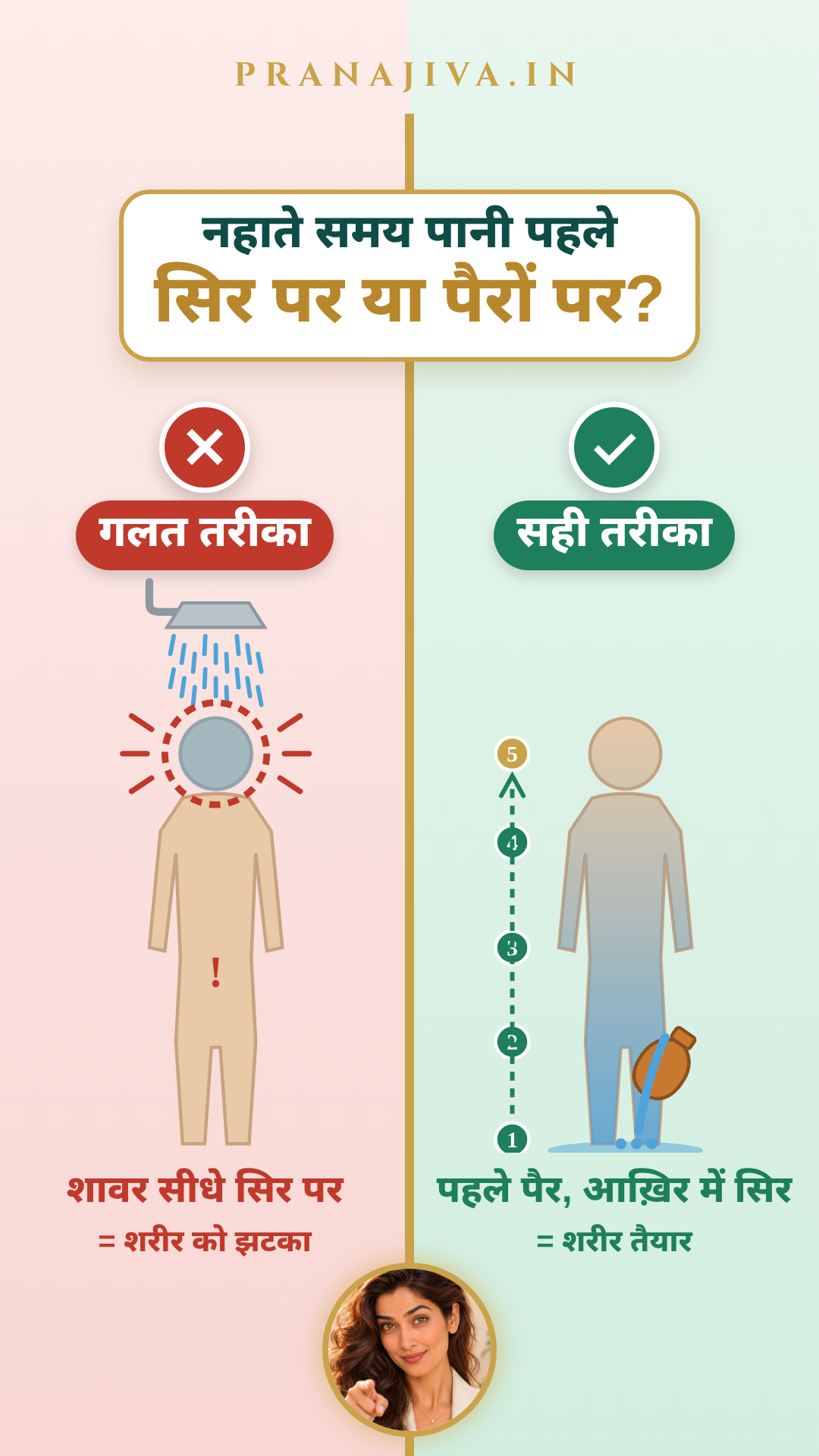
Today we walk into the bathroom, turn on the shower and put our head straight under it. The very first stream lands on the head. Ayurveda and basic physiology both suggest a better order.
What you need
- Your usual bath water
- For the head: lukewarm or room-temperature water — not hot
- Optional: a mug or lota, if you bathe with a bucket
How to do it
- Feet first (10–15 seconds). Pour water over both feet, or stand so the shower reaches your feet before anything else.
- Then the knees and legs (10 seconds). Let the water move up slowly.
- Then the belly and lower back (10 seconds).
- Then the shoulders, arms and chest (10–15 seconds). By now your body has had time to adjust.
- Head last. Finish by wetting your head — with lukewarm or normal water, never hot.
How often
Every bath. It takes no extra time — only a change of order. It matters most on cold mornings, with cold water, and for anyone who already has blood-pressure or heart concerns.
Why it works
The cold shock response. When cold water suddenly hits the body, it reacts with a jolt. Heart rate, breathing and blood pressure all jump for a short while. Cold water landing straight on the head and face can make that jolt sharper.
Giving the body a warning. Starting at the feet lets the body register the change in temperature first. As the water climbs — knees, belly, shoulders — the heart and blood vessels get time to settle into it. There is no sudden shock; the body is ready.
What Ayurveda says about hot water and the head
The Ashtanga Hridaya (Sutrasthana 2/17) puts it plainly: hot water poured over the body below the neck builds strength, but the same hot water on the head weakens the hair and the eyes. Hence the classic rule — warm water for the body, lukewarm or cool water for the head.
उष्णाम्बुनाऽधःकायस्य परिषेको बलावहः । तेनैव तूत्तमाङ्गस्य बलहृत्केशचक्षुषाम् ॥
Before you try this
- Take care: if you have high blood pressure or a heart condition, avoid very cold water altogether and follow the feet-first order every time.
- Children and the elderly: the same order applies; keep the water comfortably warm for the body.
- Don't overdo the heat: very hot showers on the head are exactly what the classical text warns against.
This article shares traditional Ayurvedic guidance for general wellbeing. It is not a diagnosis or a treatment. If you have a heart or blood-pressure condition, please consult a qualified healthcare professional about what is safe for you.
This is traditional Ayurvedic guidance shared for general wellbeing. It is not a diagnosis and not a substitute for medical advice. If a symptom is severe, persistent or worsening, or you are pregnant, taking prescribed medicine or managing a diagnosed condition, speak to a qualified doctor before trying it.
Pairs well with this
Other ways to approach the same thing.
- Remedy· Teas & Decoctions
Tulsi & Ginger Kadha
A warming black-pepper and ginger decoction with tulsi, for a loose cough and a heavy chest in the cold months.
Tea or drink · 10 min to make
- Understanding· Herbs & Kitchen Foods
Anar: The Fruit With a Lock Inside
Why two people can eat the same pomegranate and get different benefits — and what Ayurveda already knew about this unusual sour fruit.
- Understanding· Daily Routine (Dinacharya)
Ayurvedic Morning Habits, Rated
Five viral morning rituals, scored out of ten. Which ones Ayurveda backs, which need a tweak, and how to do each one properly.
More in Daily Routine (Dinacharya)
- Understanding· Daily Routine (Dinacharya)
Ayurvedic Morning Habits, Rated
Five viral morning rituals, scored out of ten. Which ones Ayurveda backs, which need a tweak, and how to do each one properly.
- Understanding· Daily Routine (Dinacharya)
The Night Screen Routine for Tired Eyes
A simple evening and morning routine for anyone whose last look of the day is a glowing phone — and whose eyes feel it.