Remedy
Dalchini & Elaichi Tea
A fragrant cinnamon and cardamom tea made with no tea leaves at all — warming, and entirely caffeine-free.

By PranaJiva
Editorial Team
- Form
- Tea or drink
- Preparation
- 10 minutes
- Makes
- 2 cups
- Best time
- Morning, Evening
- Suits
- Vata, Kapha
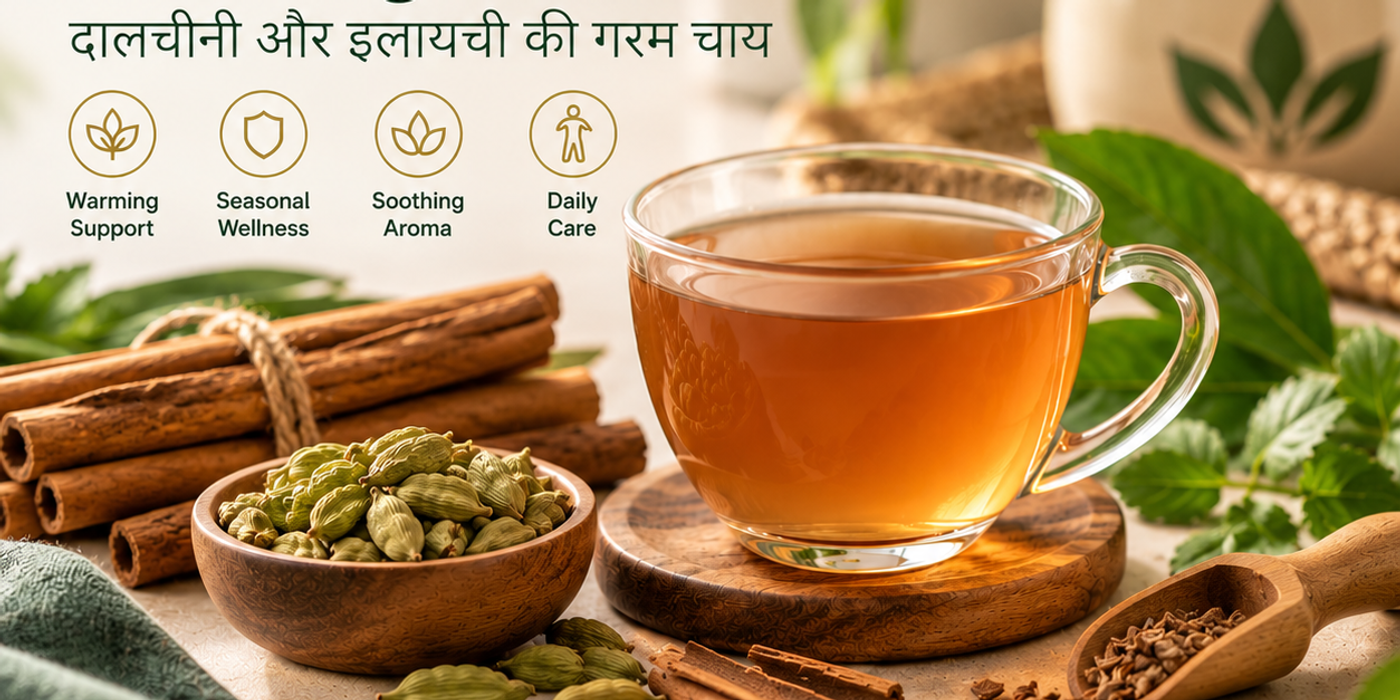
What you need
- 2¼ cups Water
- 1 small stick, 2–3 cm Cinnamon (dalchini) (Ceylon cinnamon if you drink it often — see the cautions)
- 2 pods Green cardamom (elaichi) (lightly cracked)
- 1 tsp in total Jaggery (stirred in while warm, optional)
How to make it
Crack the cardamom pods open and measure out the cinnamon.
1 minute
Bring the water to a boil and add both spices.
1 minute
Cover and let it simmer lightly.
6 minutes
Switch off, let it steep, then strain.
2 minutes
Stir in the jaggery while it is still warm, if you are using it.
How much, and how often
One small cup, occasionally. Avoid strong concentrated cinnamon decoctions and daily medicinal-style use — see the note on coumarin below.
Best taken: Morning, Evening
When to expect a change: The warmth and the smell are the point and they are immediate. There is no validated timeline for anything else, and nothing else is being claimed.
Why it works
Two spices, and one thing worth knowing
Dalchini and elaichi are the aromatic backbone of masala chai, and this is essentially that cup with the tea leaves and the milk taken away. What is left is warming and sweet-smelling without any caffeine in it, which is the whole reason to make it in the evening.
The one thing worth knowing is which cinnamon you have. Most cinnamon sold in India is cassia — thick, hard, dark, rolled in a single thick layer — and it carries coumarin, which accumulates and is hard on the liver at repeated high intakes. Ceylon cinnamon is pale, brittle, and rolled in many thin layers like a cigar, and has almost none. For a cup now and then it does not matter. For a daily habit it does.
Before you try this
Do not use if
- You are allergic to cinnamon or cardamom
- You have liver disease — the coumarin in cassia cinnamon is the reason
Take care
- Cassia cinnamon — the common, thick, dark variety sold as cinnamon in most of India — contains coumarin, which is hard on the liver in repeated high doses. Ceylon cinnamon contains very little. If you are drinking this often, buy Ceylon.
- Talk to your doctor first if you take glucose-lowering medication. Cinnamon is widely claimed to affect blood sugar, and whatever the truth of that, it is not something to layer on top of a prescription unsupervised.
- One small cup. Doubling the cinnamon does not double anything useful.
- Pregnancy, breastfeeding & children
- Keep to ordinary food quantities. Medicinal use of cinnamon in pregnancy, while breastfeeding or for children needs a clinician's advice first.
- How long is too long
- An occasional cup rather than a daily habit, unless you are using Ceylon cinnamon. There is no course here to complete.
This is traditional Ayurvedic guidance shared for general wellbeing. It is not a diagnosis and not a substitute for medical advice. If a symptom is severe, persistent or worsening, or you are pregnant, taking prescribed medicine or managing a diagnosed condition, speak to a qualified doctor before trying it.
More in Teas & Decoctions
- Remedy· Teas & Decoctions
Cumin, Coriander & Fennel Tea
A gently spiced, caffeine-free seed infusion, traditionally taken after meals as part of an Ayurvedic digestive routine.
Tea or drink · 12 min to make
- Remedy· Teas & Decoctions
Ajwain & Saunf Kadha
An aromatic carom-seed and fennel decoction, built on the familiar Indian habit of chewing spices after a meal.
Tea or drink · 10 min to make
- Remedy· Teas & Decoctions
Lemongrass & Ginger Tea
A bright, citrus-scented cup warmed with a little ginger — a caffeine-free daily ritual rather than a remedy.
Tea or drink · 10 min to make